
Hi everyone.
Today is moving day... Yes, this blog is moving to Wordpress (http://modernacoustic.com)!
I promise it will be worth your while to join me there. If you've liked the content you've read here, or are just finding it for the first time, I promise to dazzle you with my words of wisdom about bands I love. Whether your a fan of Grace Potter, Lori McKenna, Josh Ritter, Patty Griffin, or the hundreds of other musicians and bands I have written about here, I promise to continue to bring you all the CD and concert reviews, all the info that I find interesting and newsworthy.
The move allows me to have all my content, my magazine (have you seen my magazine?) and my blog all on the same site. In the past, some people who read my music blog had no idea I also published a music magazine and vice versa.
Well, that is all changing.
It's exciting, with only a touch of sadness. Sadness in that I really have liked Blogger's features. The way it is set up is perfect, I think, for a blog. I'm addicted to the Stats!
Anyway please, please join me at my new site, once again, http://modernacoustic.com.
I think you'll really like it.
Oh, and don't worry, all the content on this site is now over there as well.
Thanks so much for checking in, and checking out the new site. I think you will find it very cool.
Rich
March 27, 2011


March 26, 2011
Grace Potter and the Nocturnals at the House of Blues Boston, March 25
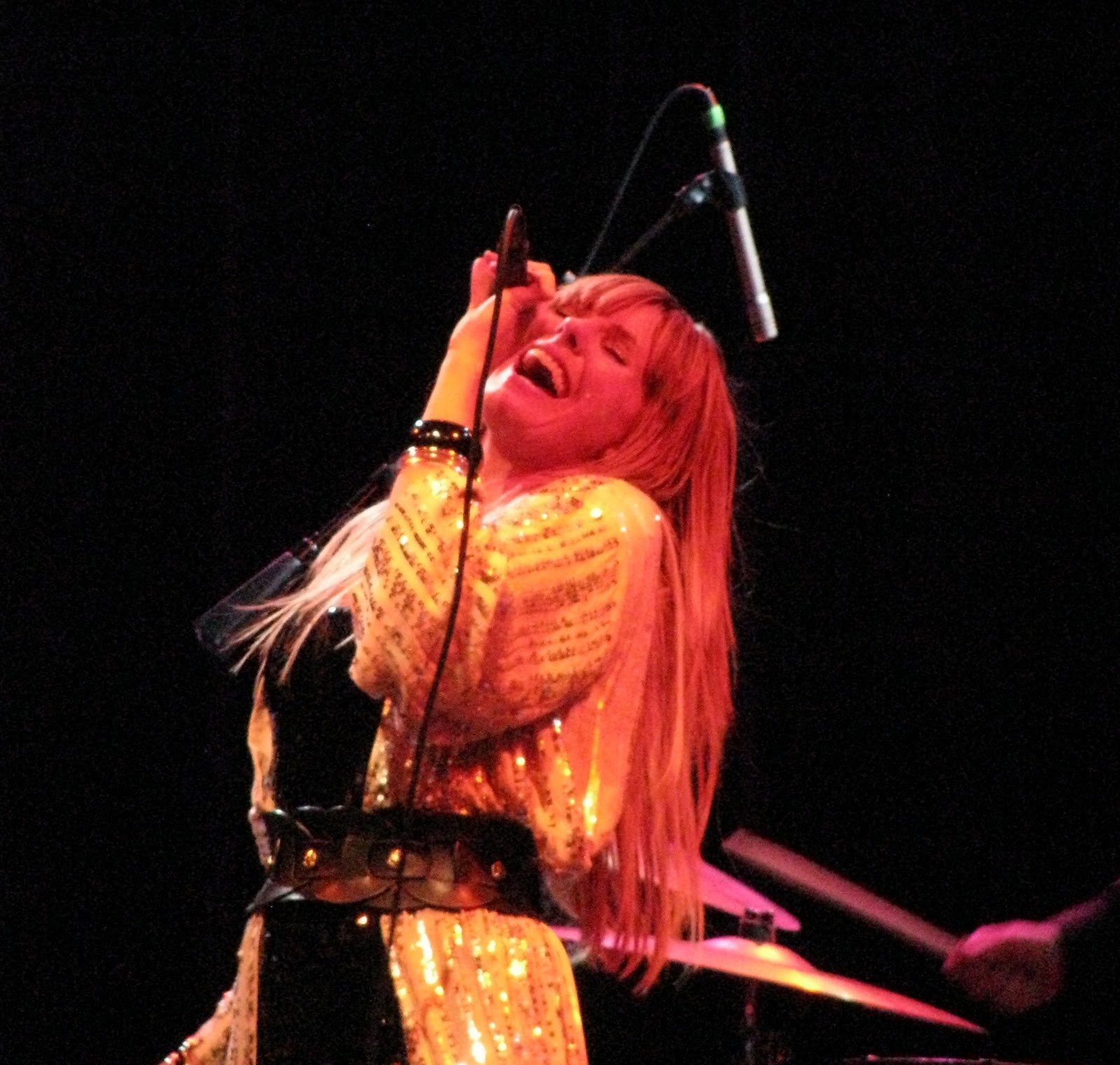
This is the third time I've seen Grace and the Nocturnals in about a year and a half. Each time I reviewed the shows, I thought I knew what kind of band they wanted to be.
The first, in Nov. 2009 and just after the formation of the new Nocturnals (adding bassist Cat Popper and second guitarist Benny Yurco), I guessed they wanted to be a female-led version of the Allman Brothers. They had already had their makeover -- snazzy short dresses for Grace and Cat, suits for the guys -- but for the most part they still seemed to be geared to jam.
The second time they came around, last May, I was sure they wanted to be a bedazzled version of Heart. They still jammed but were starting to add a more sharp stage presence, really started to gel as a band. Popper, who stays mostly in the background and plays a solid bass, adds another dimension and a second female voice, which helps the band's balance (and obviously helps draws some eyes).
So here they are now, post-VH1 Divas show (with Katy Perry and Nicky Minaj!!?!), have dazzled audiences on every late-night talk show out there, and crossed the country spreading the love of Grace. They are now officially their own band, one that can crank out songs like "Paris" and "Medicine," equal parts solid pop and mesmerizing jam rock. They are fronted by a woman who twirls like Stevie Nicks and can belt out tunes like Heart's Ann Wilson.
Last night's show opened with mostly newer tunes -- "Only Love," "Hot Summer Night" and "Low Road" -- with only "Toothbrush & My Table" as the only older song in the first four. But while "Paris" gets most of the play when the band hits the late-night circuit (and who can blame them, the song is built to kick ass) and is the surefire main-set show closer, Grace & co. gives her past album tunes plenty of space in concert.
"Low Road" led right into "Joey" and had the Friday-night crowd in full lather, singing all the words. It should be noted that it didn't take too much to get the crowd into it: Blues & Lasers, basically three members of the Nocturnals plus a second drummer and a different bass player, were the openers for the evening and during the break between bands, there was a spontaneous singalong to Bon Jovi's "Don't Stop Believin'" as it played on the venue's sound system.
Other highlights included a wildly pschedelic intro to "Mastermind" and a nice version of "Treat You Right," featurning just Grace, Scott Tournet and Benny, all playing acoustic guitars. That led into a wild flurry of tunes that bled into each other: "Stop the Bus," "Big White Gate" and the great "Nothing But the Water," parts 1 (Grace solo) and 2 (the electric band version). By this time Grace was whirling like a Red Bull-fueled Stevie Nicks as she moved seamlessly from her Hammond B3 stage right to center stage strutting around playing her flying V.
After "Why Don't You Love Me," the band brought down the house with "Paris." Scott, who had torn it up all night while playing in both bands, is such a great joy to listen to. He can play tasty or incredibly nasty. On "Paris," he was downright nasty.
For the encore, Benny came out by himself and played some nifty acoustic for the intro of Heart's "Crazy on You." Then the band walked out, or in Grace's case, skipped, twirled, and jumped (in heels!) out and blew the song out of the water. If you thought Ann Wilson could really hit those high notes, well, Grace takes them into the stratosphere. They finished with "Medicine," which as a pop song is nice on the album. But it something special when it becomes the rocking closer, complete with full-band drum solo in the middle.
It was a phenomenal way to end the night, and perfectly fitting to what the band is right now -- emerging pop stars who can really rock.
For more pics, click HERE
The setlist
Only Love
Hot Summer Night
Toothbrush And My Table
Low Road >
Joey
Mastermind
Money >
Apologies >
Tiny Light
Treat You Right >
Stop The Bus >
Big White Gate >
Nothin’ But The Water Part I >
Nothin’ But The Water Part II >
Why Don’t You Love Me
Paris
--
Crazy On You >
Medicine
March 24, 2011
Argggh!
So there is a new issue of Modern Acoustic magazine that is all done and ready to roll. However, I'm having some website issues that is causing its delay. I have posted the three new CD reviews from the issue: Lucinda Williams' "Blessed" (click HERE to read), the Low Anthem's "Smart Flesh" (HERE) and the Submarines' "Love Notes/Letter Bombs," which is due out April 5 (HERE). When the new issue is up, you'll find it at my magazine site, ModernAcoustic.com.
And in case you are interested, I am working on a brand-new website that will merge the magazine and the blog into one handy site. I'm not sure exactly when that change will happen, but it means leaving theis Blogger site and merging all content onto Wordpress. Luckily, all content on this site, will move to the new one.
I will post a note and a link here when the change happens (probably still a month at least off).
Thanks everyone who supports my musical sites. I love doing this and will continue trying to provide great content.
And in case you are interested, I am working on a brand-new website that will merge the magazine and the blog into one handy site. I'm not sure exactly when that change will happen, but it means leaving theis Blogger site and merging all content onto Wordpress. Luckily, all content on this site, will move to the new one.
I will post a note and a link here when the change happens (probably still a month at least off).
Thanks everyone who supports my musical sites. I love doing this and will continue trying to provide great content.
CD review: the Submarines, "Love Notes/Letter Bombs"

(Out April 5)
The first thing that becomes clear on the new album, “Love Notes/Letter Bombs ,’’ is that Blake Hazard and John Dragonetti, the duo that makes up the Submarines, is that they are still in love – even if everything isn’t always perfect.
That might not completely matter since their first album, “Declare a New State,” ostensibly about their breakup and reconciliation, put them on the musical map, and their second one, “Honeysuckle Weeks,’’ about their reconnecting in everyday life, hit it big with the song “You, Me & the Bourgeoisie” (which was nearly the iPhone theme song for a while).
“Love Notes/Letter Bombs” is sort of the pair’s settling in album – you know, alternating between loving each other and annoying each other as married couples do.
“There was so much love exploding into the songs, but the tensions were just as strong,” says Hazard.
On opener “Shoelaces,’’ Dragonetti sings “I’ve had better days than this/ words trip like untied shoelaces/ Still you’re worth falling down for once in a while.” The pair trades off lines about trying to come to grips with their relationship.
Fans who fell in love with the bubbly, electronic beats of “Honeysuckle Weeks” will be happy to hear that the group’s sound hasn’t changed a great deal. (They employed a live drummer, Jim Eno of Spoon, this time instead of the computerized one in the past.)
“Love Notes” initially may not be catchy as “Honeysuckle Weeks,” but the songwriting and lyrics continue the band’s growth.
Many tunes, like “Fire,” “Tiger” and their first single “Birds” (lots of one-word titles on the album!) feature Hazard’s dreamy organ, Dragonetti’s fuzzy guitar and a steady beat enhanced by various techno effects and hand claps. Another tune, “Plans,” has already gotten some play in a closing scene on an episode of “Grey’s Anatomy.”
Our favorite song is the finale, “Anymore,” a Hazard tune in which she’s vulnerable and trying to figure out where their relationship stands. “And it’s not the first time/I’ve heard you say/why can’t you just love me the same way/I disappoint you try as I may/you might be better off without me these days.”
CD review: the Low Anthem, "Smart Flesh

“Smart Flesh
 ” is the follow-up to their hugely successful second album, “Oh My God, Charlie Darwin,” and continues the band’s trip into the ethereally intricate calm. Yes, they do break out occasionally, but “Smart Flesh” was recorded in an abandoned pasta factory in Providence, and the ghostly beautiful sounds of acoustic guitar, oboe, organ, and the like ring and echo off its empty walls.
 This is immediately apparent on the opening track, the haunting “Ghost Woman Blues.” “Apothecary Love,” one of my favorite songs here, sounds like James Taylor meets Neil Young, with its lilting country melody.
The blending of voices of Ben Knox Miller, Jeff Prystowsky, Jocie Adams, and Mat Davidson is what really sets the band apart. And each is a talented musician, playing multiple instruments – Adams, for instance, plays oboe, the crotales, and even electric bass.
Check out the multiple oboe instrumental “Wire.” On “I’ll Take Out Your Ashes,” plucking banjo mandolin backs the singular voice of Knox Miller singing as an old man: “For time just ain’t no healer, with your ashes sittin’ there/I know you have been counting on me/Ever since your sad cremation day/I scanned all your Alzheimer’s poetry for all that I wished that it would say/It’s a sad and guilty feeling/Since I did not take out your ashes/Whatever I was fearing, never came to passing.”
Put on your headphones to listen to the hushed “Love and Alter” and the title track for a real sonic treat.
As stated, the band breaks out and rocks on a pair of tunes, the 9/11-inspired “Boeing 737” (opening line: “I was in the air when the towers came down/ In a bar on the 84th floor”) and a raucous guitar and organ “Hey, All You Hippies.”
CD review: Lucinda Williams, "Blessed"

 ,” her 10th studio album, are inspired, varied and contain some of her best writing in years. It’s an emotional album, with songs about a spectrum of loss and love, sung with depth and played with both subletly and with fire.
The album opener, “Buttercup,” tells a lover goodbye, with a nasty sneer and an electric guitar and organ backing.
The next two songs, “Copenhagen” and “Born to Be Loved,” are softer in heart and in tempo. The former mourns the loss of a friend from afar, while the latter is a nice, slow blues ballad. The lyrics are simple: “You weren’t born to be mistreated/And you weren’t born to be misguided/You were born to be loved /You were born to be loved.” It reminds me a lot of songs like “I Envy the Wind” from “Essence,” where she repeats phrases and feelings for emphasis.
“Seeing Black,’’ written to Vic Chestnutt, who committed suicide on Christmas Day 2009 is, excuse the pun, a killer. Like “Drunken Angel” – which was written about the demise of musician and friend Blaze Foley on her acclaimed “Car Wheels on a Gravel Road” album (see Page 11) – “Seeing Black” is rife with not only sadness but an anger directed at the man for leaving life too early.
“Soldier’s Song,” sung to perfection in Lucinda’s tired drawl, is written from the perspective of a soldier overseas, with lyrical images that trade off between the tragic life in combat and thoughts of his family back home: “I hear echoes of shots/Baby’s only thinkin’ sweet thoughts /Why the hell did they send me here to fight?/Baby kisses my picture and turns off the light.” It’s a poignant reminder of what some families are currently going through.
The album, in general, has some nice guitar flourishes. Redemption song “Blessed” is sparked by some crisp electric playing and “Ugly Truth” offers some tasty licks.
The gospel-ish “Convince Me,” features a soulful organ and searing guitar, and the closing love song, “Kiss Like Your Kiss,” is a perfect ending to a superb emotionally wrought album.
One more note: If you get the deluxe version of “Blessed,” you get a second set of the songs, stripped down to their bare bones. Williams dubbed these “The Kitchen Tapes,” just her voice and her guitar. Some of the songs, including the opener, “Buttercup,’’ a rocker on the album, is really great in its skeletal form. It’s worth the extra, minor investment to purchase them as well.
March 15, 2011
Lyrically Speaking: For the Turnstiles

I'm not sure how I ended up with the album "Decade
 ." I think I bought it from a used record store on one of the many excursions into Cambridge as a teen. My friends and I, or even sometimes me on my own, would drive into Harvard Square and spend hours walking the streets from used record store to used record store looking for cool albums or even just checking out the album covers... something today's teens probably don't get to experience. That album cover, with Neil's arms and head sticking out from his guitar case, is one of the classics.
 " had just come out, which may have propeled me into a search for older, more obscure Neil. The best thing about "Decade" is that it isn't so much a greatest hits album as a look back at a young career, mixing the hits with cool songs that hadn't made the radio.
When I first heard "For the Turnstiles," which was originally released on the album "On the Beach," it wasn't like anything I had heard before. Neil plucks out a haunting, almost sad bluegrassy melody on banjo and Ben Keith adds nifty Dobro over the pair's harmonizing. Being a big baseball fan, the lyrics "All the bushleague batters/Are left to die on the diamond/In the stands the home crowd scatters/For the turnstiles" really threw me as I tried to figure out what was going on.
To this day, the sailors, the explorers and the ballplayers kind of haunt me. What is Neil trying to say? Here is one explanation, though I do not know its origin: The song was "inspired by the stadium tour he had just completed with Crosby, Stills & Nash. Mr. Young was clearly disturbed by the fact that big business was starting to take over rock and roll and art was suffering for commerce. The song foretells of the selling out of musicians and the forming of corporate rock."
OK, I guess if you dig really deeply into the lyrics you can come up with that. I'd also say this is what's missing from Neil's music today... a little subtlety, mystery.
In the past couple of years there have been some nifty covers of the song: The Be Good Tanyas do a great version on their album, "Hello Love
 " and Redbird recently released a slowed-down version on their album "Live at Cafe Carpe
 ." Check them out.
For the Turnstiles
All the sailors
with their seasick mamas
Hear the sirens on the shore,
Singin' songs
for pimps with tailors
Who charge ten dollars
at the door.
You can really
learn a lot that way
It will change you
in the middle of the day.
Though your confidence
may be shattered,
It doesn't matter.
All the great explorers
Are now in granite laid,
Under white sheets
for the great unveiling
At the big parade.
You can really
learn a lot that way
It will change you
in the middle of the day.
Though your confidence
may be shattered,
It doesn't matter.
All the bushleague batters
Are left to die
on the diamond.
In the stands
the home crowd scatters
For the turnstiles,
For the turnstiles,
For the turnstiles.
A rare electric version by Neil in 2008
Subscribe to:
Posts (Atom)


